
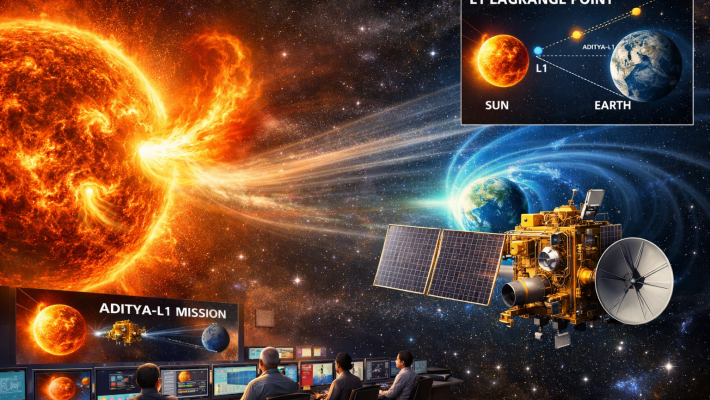
ISRO’s Aditya-L1 Mission Strengthens Solar Research and Space Weather Forecasting
New Delhi | January 2026
The Indian Space Research Organisation (ISRO) continues to make significant advancements in solar science through its Aditya-L1 mission, India’s first dedicated solar observatory. Positioned approximately 1.5 million kilometers from Earth at the Sun–Earth Lagrange Point (L1), the spacecraft enables continuous and unobstructed observation of the Sun.
Unlike low Earth orbit satellites, Aditya-L1’s placement at L1 allows it to monitor solar activity without interruptions caused by Earth’s shadow. This strategic position enhances real-time detection of solar phenomena such as solar flares, coronal mass ejections (CMEs), and variations in solar wind speed.
Advanced Scientific Payloads
The mission carries seven state-of-the-art scientific payloads designed to study the solar photosphere, chromosphere, and corona. Instruments such as the Visible Emission Line Coronagraph (VELC) and Solar Ultraviolet Imaging Telescope (SUIT) are providing high-resolution data that help scientists understand the Sun’s outer atmosphere and magnetic field behavior.
Scientists confirm that these instruments are functioning as expected and are continuously transmitting valuable datasets to ground stations. The collected data is being analyzed by ISRO and shared with academic institutions to support collaborative solar research.
Importance for Space Weather Monitoring
Solar activity directly impacts Earth’s space environment. Intense solar flares and CMEs can disrupt satellite operations, GPS navigation systems, aviation communication, and even terrestrial power grids. Aditya-L1’s observations contribute to early warnings of such events, allowing preventive measures to be taken.
According to space science experts, improved space weather forecasting is becoming increasingly critical due to growing dependence on satellite-based infrastructure. Aditya-L1 strengthens India’s ability to independently monitor solar conditions and respond to space weather threats.
India’s Growing Role in Global Space Science
With the success of Aditya-L1, India joins an elite group of space-faring nations that operate dedicated solar observatories. The mission complements international efforts by agencies such as NASA and ESA, contributing to a broader global understanding of solar dynamics.
ISRO officials have stated that Aditya-L1 is expected to operate for several years, generating long-term datasets essential for studying solar cycles and their effects on Earth’s climate system and space environment.
The mission underscores India’s expanding capabilities in space research and its commitment to advancing scientific knowledge through cost-effective and innovative missions.
— This article was generated and refined using AI-assisted tools to enhance clarity, structure, and readability while maintaining factual accuracy.
Frequently Asked Questions (FAQ)
What is ISRO’s Aditya-L1 mission?
Aditya-L1 is India’s first dedicated solar observatory mission launched by the Indian Space Research Organisation (ISRO) to study the Sun from the Sun–Earth L1 Lagrange point.
Why is the Aditya-L1 mission important?
The mission helps scientists understand solar flares, coronal mass ejections, and space weather, which can impact satellites, communication systems, and power grids on Earth.
Where is Aditya-L1 positioned?
Aditya-L1 is positioned at the Sun–Earth L1 Lagrange point, approximately 1.5 million kilometers from Earth, allowing continuous observation of the Sun.
What does Aditya-L1 study?
The mission studies the Sun’s photosphere, chromosphere, corona, solar winds, and magnetic field to improve space weather forecasting.
Who operates the Aditya-L1 mission?
The mission is operated by the Indian Space Research Organisation (ISRO) with support from various Indian research institutes.